

The FLEXHYBAT project demonstrates a transformative approach to grid stability. In this results section, we detail how the hybridisation of traditional hydropower plants with battery storage mitigates the mechanical stress caused by automatic Frequency Restoration Reserve.
Our evidence-based conclusions, ranging from optimal battery sizing to a 50% reduction in mechanical “mileage”, provide a clear roadmap for plant operators to extend equipment longevity while maintaining high-performance grid services. Discover the data-driven breakthroughs that are making hydraulic turbines more flexible and durable for the energy transition.
Battery sizing for PSP providing aFRR
Pumped-storage hydropower plants are critical for stabilising the electrical grid. However, the increasing need to regulate frequency (automatic Frequency Restoration Reserve) forces these massive machines to make constant, rapid mechanical adjustments. This leads to excessive wear and tear on critical components, particularly the guide vanes.
This study proposes hybridising the hydropower unit by adding a Battery Energy Storage System (BESS). For this two-year-long study, a pumped storage located in Spain was used as a reference. The unit was extensively monitored and data was acquired for more than 6 months. With that, the operation of the non hybridised unit has been properly characterised. Thanks to an advanced SIMSEN model, a digital twin of the hybridised unit was created.
The main conclusion is that the battery acts as a smoother of the operation during aFRR, handling the fluctuations from the grid imposed by the grid itself.
Small battery, massive impact
You do not need a large battery to get big results. The study found that a battery with a power rating of just ~4% of the turbine’s capacity (e.g., 4 MW for a ~100 MW unit) is the “sweet spot”.
50% reduction in wear
This compact battery configuration is sufficient to reduce the accumulated movement (“mileage”) of the mechanical actuators by up to 50%. By absorbing the fluctuations of the secondary frequency control, the battery drastically cuts down the mechanical stress on the plant.
50% reduction in sign changes
With the same configuration, the number of direction changes will be also drastically reduced. Every direction change is a huge force on the guide vanes mechanisms and therefore, this KPI is proportional to the fatigue or tear on the guide vanes. Some studies reported this as a critical degradation in flow control mechanisms such as the guide vane.
Ramping rate
The battery must be fast. A ramping in the order of 0.3 to 1 seconds is recommended to effectively benefit the reduction of wear and tear. Nevertheless, there are some BESS already implemented with this capability.
Smart sizing
There is a law of diminishing returns. Increasing the battery size beyond this optimal point, or increasing its energy capacity ratio (capacity/max power of the battery) beyond 2 hours, may bring only minor additional benefits.
Hybridisation with batteries is a highly efficient solution to reduce wear and tear in hydraulic turbines providing ancillary services such as Secondary Frequency Control. By installing a relatively small and cost-effective battery system, operators can extend the lifespan of their heavy hydraulic equipment while maintaining an excellent service to the power grid.
* NOTE: A paper on this study has been sent for publication and will be made available soon on this site. Detailed results and models will be shared as Open Access. *
BESS to increase the RUL of the driving mechanism
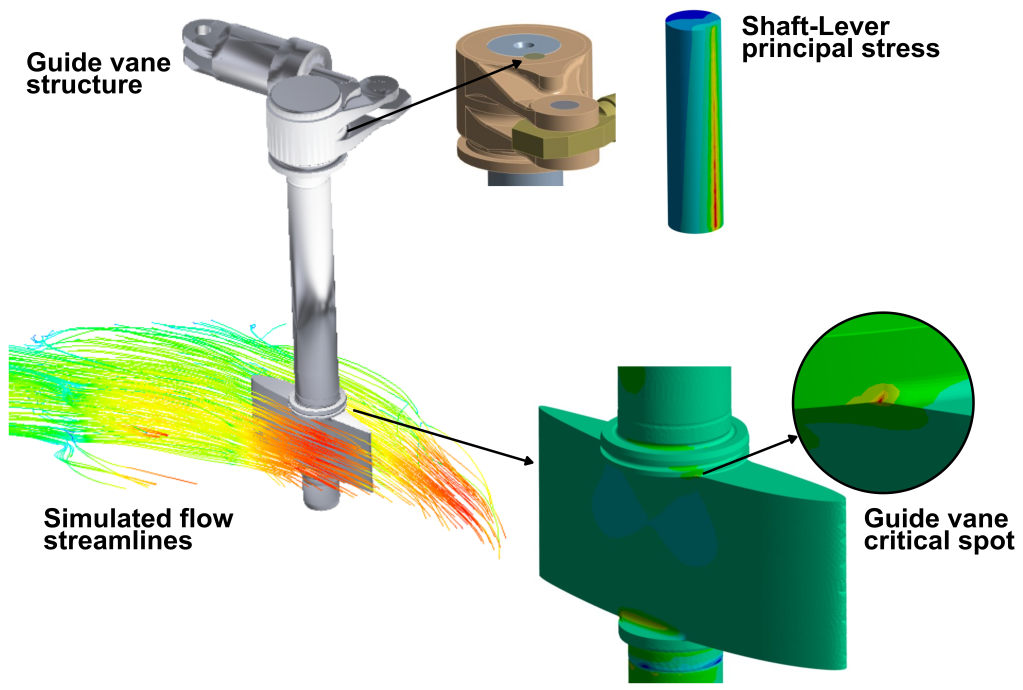
Critical components identified
The study focused on wear and tear in moving mechanical parts of the hydraulic turbine, particularly the guide vane mechanism.
High-fidelity CFD and FEM models were developed to capture the fluid–structure interaction and accurately quantify the stresses in the guide vane assembly, both with and without battery hybridisation.
Stress concentration zones
The results clearly show that the most critical stress locations are:
- The pin connecting the guide vane lever to the main shaft
- The joint between the guide vane and its shaft
These components are subject to the highest alternating stresses and are therefore the most fatigue-critical elements of the mechanism.
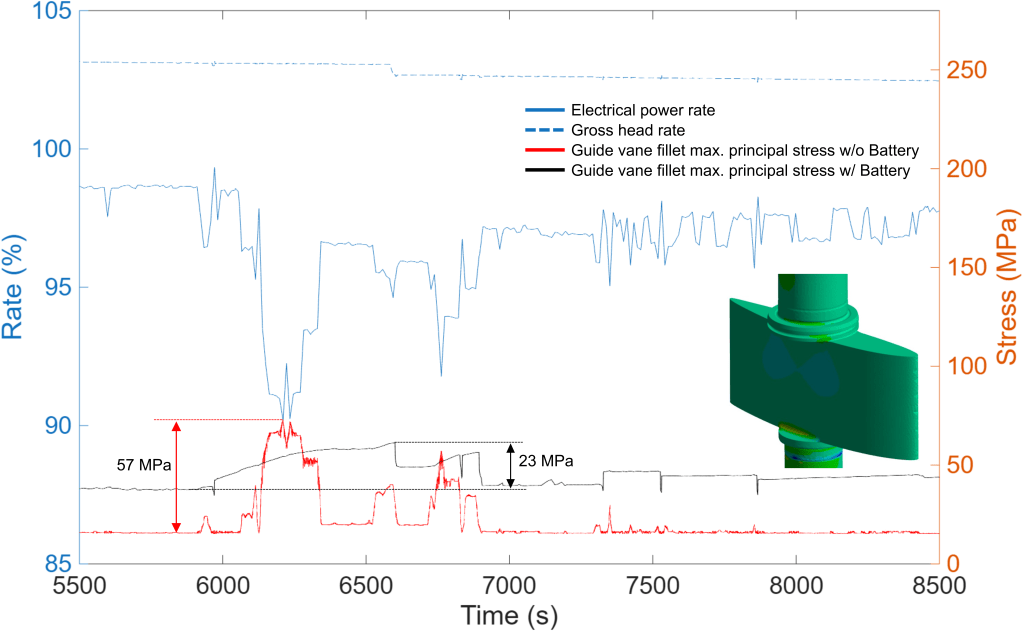
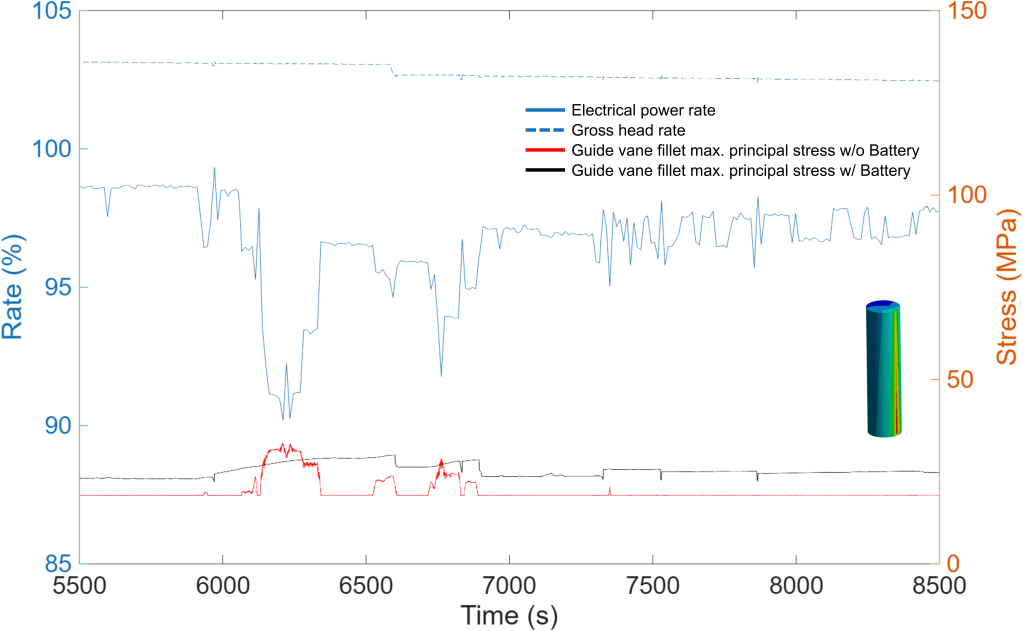
Significant reduction in alternating stress amplitudes
When the unit is hybridised with a battery system, a substantial reduction in the amplitude of the alternating stresses is observed in these critical components. By filtering fast power fluctuations, the battery alleviates the dynamic loading transmitted to the guide vane mechanism.
Drastic reduction in stress cycles
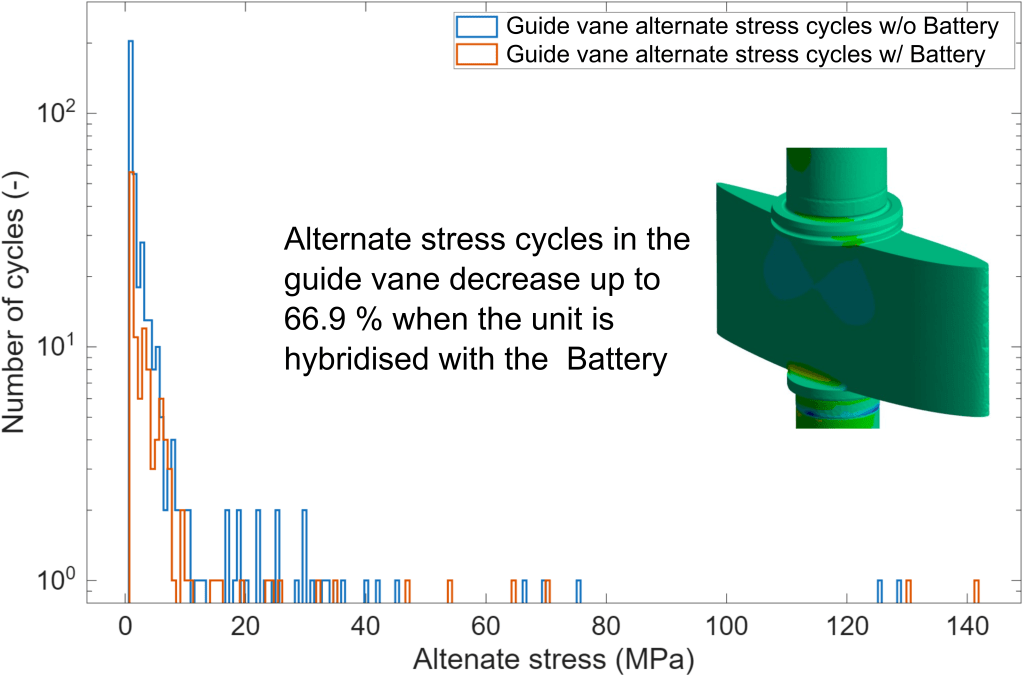
Beyond stress amplitude, the number of stress cycles experienced by the mechanical components is significantly reduced:
- A 52.2% reduction in daily stress cycles in the pin connecting the shaft and lever
- A 66.9% reduction in daily stress cycles at the guide vane–shaft fillet
These reductions represent a major improvement in fatigue life and long-term mechanical reliability.
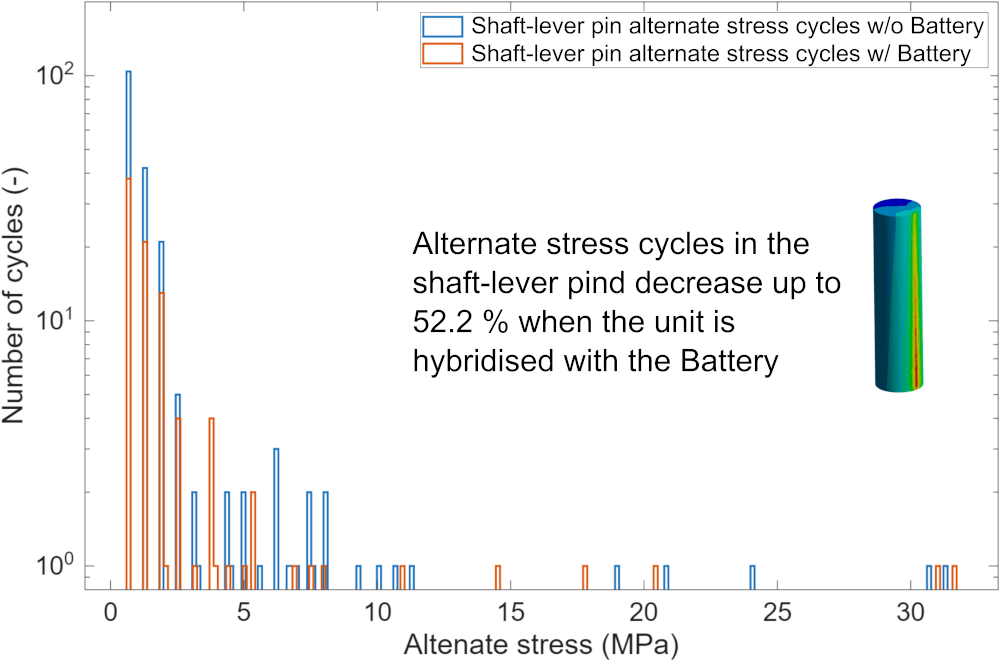
Extended lifetime of guide vane mechanisms
The combined effect of lower stress amplitudes and fewer stress cycles directly translates into reduced fatigue damage. Battery hybridisation therefore emerges as a highly effective strategy to mitigate wear and tear in guide vane mechanisms while maintaining excellent dynamic performance for grid services.
* NOTE: A scientific article presenting the detailed CFD-FEM models, stress analyses, and fatigue results is currently under preparation. *
BESS to increase the RUL of the runner
Critical runner areas identified
The study focused on the structural integrity of the turbine runner under realistic hydraulic loading conditions. The stress analysis was performed considering pressure fields obtained from:
- A high-resolution CFD simulation of the complete hydraulic machine
- A dedicated CFD model of the labyrinth seals to accurately capture local pressure fluctuations and leakage-induced dynamics
These CFD results were mapped onto detailed FEM structural models of the runner to quantify the fluid–structure interaction effects and evaluate stress distributions both with and without battery hybridisation.

The analysis clearly identified the most critical stress concentration area at the blade fillet region. Due to its geometric discontinuity and high dynamic loading, this location governs the fatigue behaviour of the runner. Consequently, the fatigue assessment was focused on this critical fillet area.
Significant reduction in stress amplitudes
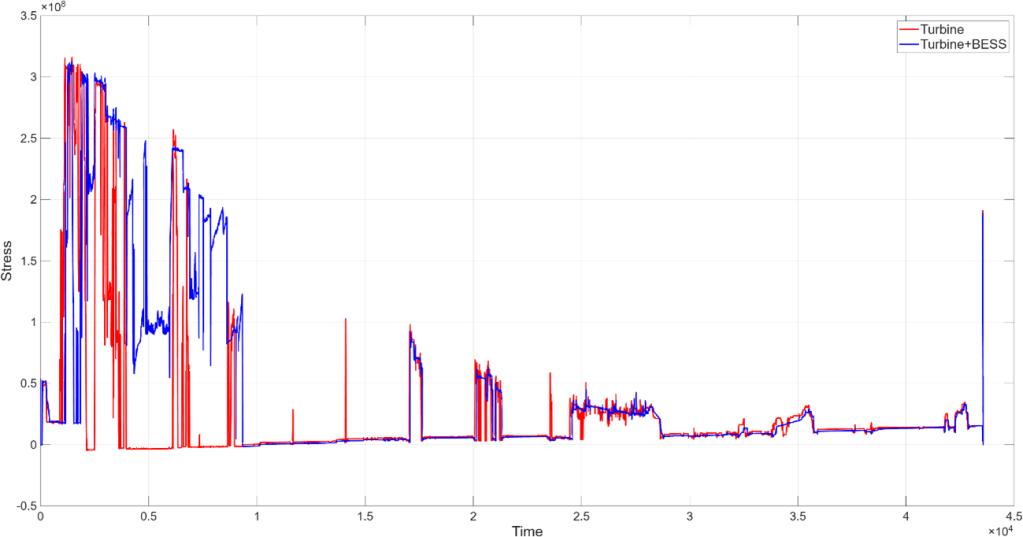
When the unit is hybridised with a Battery Energy Storage System (BESS), a clear reduction in runner stresses is observed.
This reduction is visible in:
- The alternating stress amplitudes
- The mean stress evolution along the runner revolution
By filtering fast power fluctuations and absorbing high-frequency load variations, the battery mitigates the dynamic hydraulic excitation transmitted to the runner. As a result, both peak stresses and stress oscillations at the fillet region are substantially reduced.
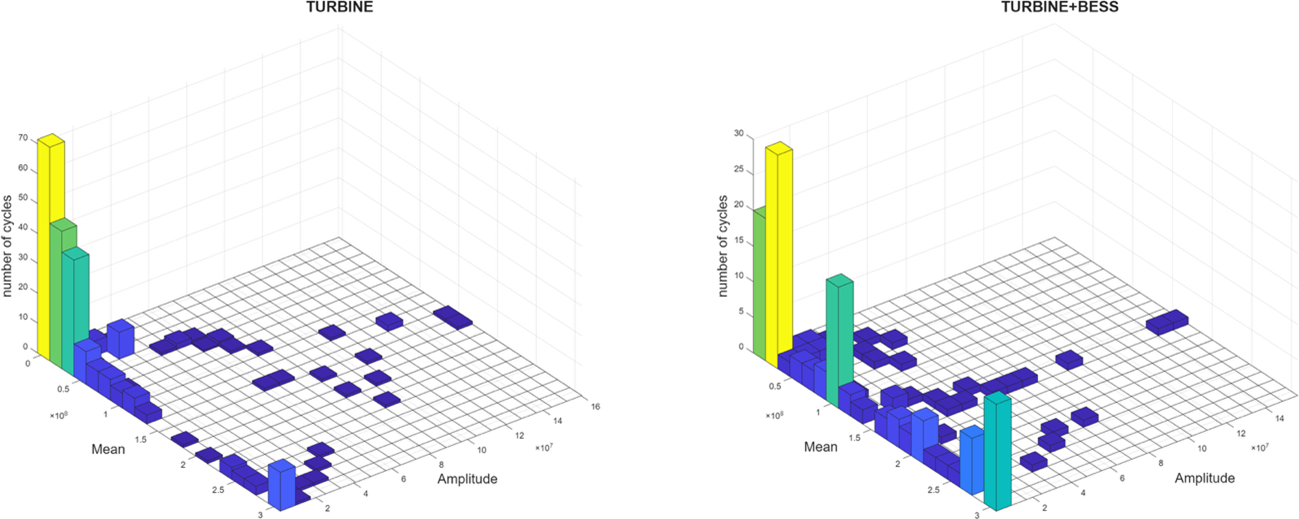
The BESS acts as a dynamic buffer between grid demands and hydraulic response, smoothing rapid transients that would otherwise induce cyclic mechanical loading on the runner structure.
Reduction in stress amplitudes
Beyond stress amplitude mitigation, the number of equivalent stress cycles experienced by the runner over a representative day is significantly reduced.
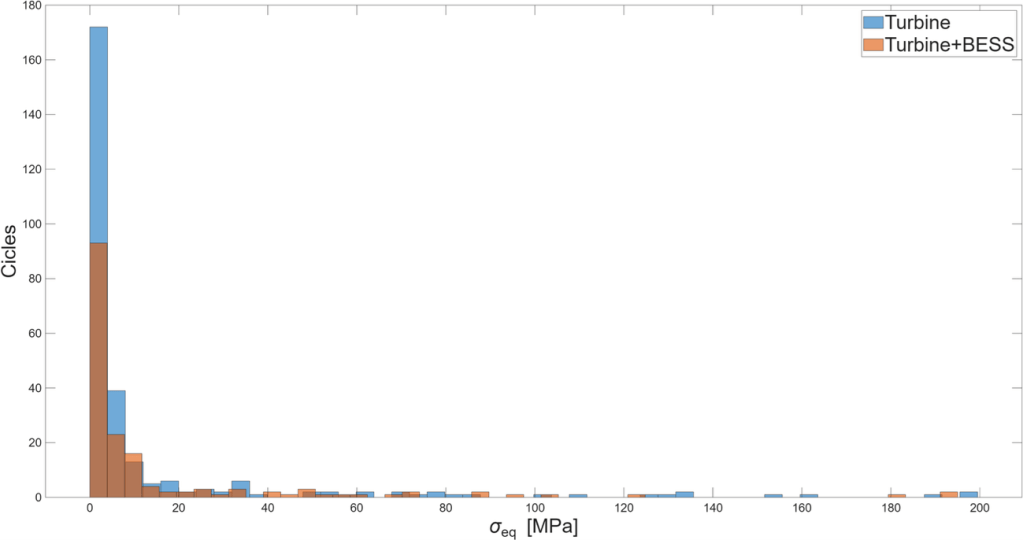
Rainflow cycle counting of the equivalent stress signal shows a 37% reduction in daily fatigue cycles in the runner fillet when the unit is hybridised.
This reduction reflects a substantial decrease in cumulative fatigue loading, particularly in the medium-to-high stress ranges that are most damaging from a fatigue standpoint.
Extended lifetime of the runner
The combined effect of lower stress amplitudes and fewer fatigue cycles directly translates into reduced cumulative fatigue damage. By attenuating rapid power fluctuations and decoupling short-term grid variability from the hydraulic machine, the BESS:
- Reduces mechanical fatigue damage accumulation
- Enhances structural reliability
- Extends the Remaining Useful Life (RUL) of the runner
From a system perspective, battery hybridisation not only protects critical hydraulic components but also improves overall grid support capabilities. The BESS enables:
- Faster frequency response
- Reduced mechanical wear and tear (fatigue) during ancillary service provision
- Smoother load-following operation
- Improved operational flexibility without penalising mechanical lifetime
Therefore, battery integration represents a dual-benefit strategy: enhancing grid stability while simultaneously increasing the mechanical durability and long-term reliability of the turbine runner.
Second-life Li-ion batteries modelling
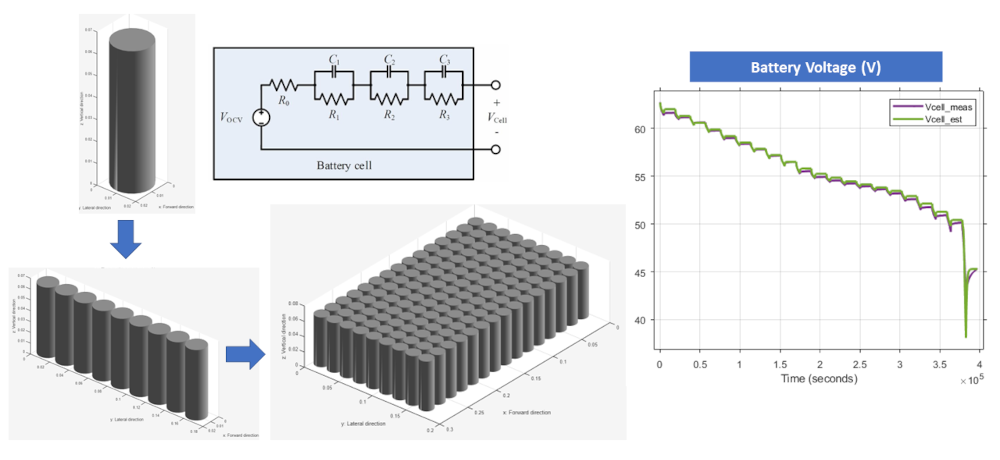
Battery modeling is being carried out after extensive cells characterization in the laboratory.
Equivalent circuit model parameters have been determined for different ambient and operating conditions.
The obtained cell model has been extended to battery pack level with Simscape software.
BESS providing fast ramp-up services and flexibility

A power change in a hydropower turbine causes an initial output power reduction due to water inertia in a penstock. By using a specifically programmed BESS, this power drop is attenuated.
These results were presented by Bryan Murray (UNIOVI) at the 2025 IEEE PES ISGT Europe Conference, under the Complementing Frequency Response of Hydropower Plants with Energy Storage presentation.

 FLEXHYBAT